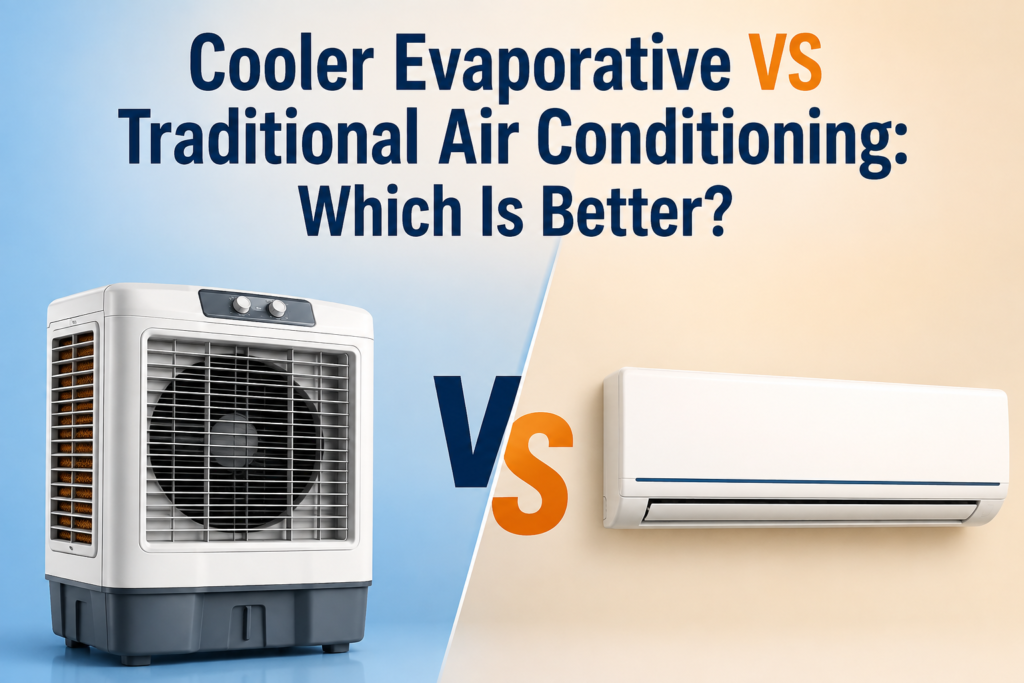
Cooler Evaporative vs Traditional Air Conditioning is one of the most common comparisons for homeowners and businesses looking for an energy-efficient cooling solution. Choosing the right cooling system depends on factors such as energy efficiency, installation costs, maintenance requirements, climate conditions, and long-term performance. Understanding these differences helps you select the best cooling system for your needs.
While traditional air conditioning has long been the preferred preference for temperature management, evaporative cooling generation has emerged as an appealing opportunity for lots of commercial and enterprise environments. When comparing Cooler Evaporative vs Traditional Air Conditioning there can be no ordinary solution due to the fact each device performs in a different way, relying on the software.
Cooler Evaporative vs Traditional Air Conditioning: What Is the Difference?
Many humans anticipate that every cooling device works the same way, but the going-for-walks standards inside the realm of evaporative cooling and air conditioning are absolutely terrific. While each system decreases indoor temperatures, they benefit from this using a one-of-a-kind era, resulting in various walking prices, maintenance requirements, and environmental influences.
Cooler Evaporative vs Traditional Air Conditioning helps explain how both cooling systems work and which option is better for different environments. Traditional air conditioners depend upon refrigeration cycles and compressors, at the same time as evaporative cooling makes use of the natural gadget of water evaporation to chill incoming air.
Key Differences Between the Two Cooling Systems
- Working Principle: Coolair evaporative cooling systems cool air by way of passing it through water-saturated cooling pads. As water evaporates, it absorbs warmth and produces obviously cooled air. Traditional air conditioners use refrigerants and compressors to cast off warmness from indoor regions.
- Energy Consumption: Evaporative cooling structures devour appreciably a bargain less energy because they function without excessively powered compressors. Traditional air conditioners require greater strength, mainly at some stage in peak summertime temperatures.
- Fresh Air Supply: Evaporative cooling continuously introduces glowing outside air into the construction, improving ventilation. Traditional AC structures generally recirculate indoor air until combined with committed air-drift systems.
- Humidity Levels: Evaporative cooling clearly will increase indoor humidity, making it perfect for decent and dry climates. Traditional air conditioners get rid of humidity, making them more powerful in humid areas.
- Environmental Impact: Since evaporative cooling avoids dangerous refrigerants and consumes much less strength, it gives a greater sustainable cooling opportunity. Air conditioning structures have a better carbon footprint due to energy utilization and refrigerant emissions.
- Installation Complexity: Evaporative cooling systems are usually tons less complicated and much less costly to put in because of the fact that they require fewer mechanical components. Traditional AC installations regularly comprise refrigerant piping, ductwork, and professional servicing.
How Does Coolair Evaporative Cooling Work Compared to Traditional Air Conditioning?
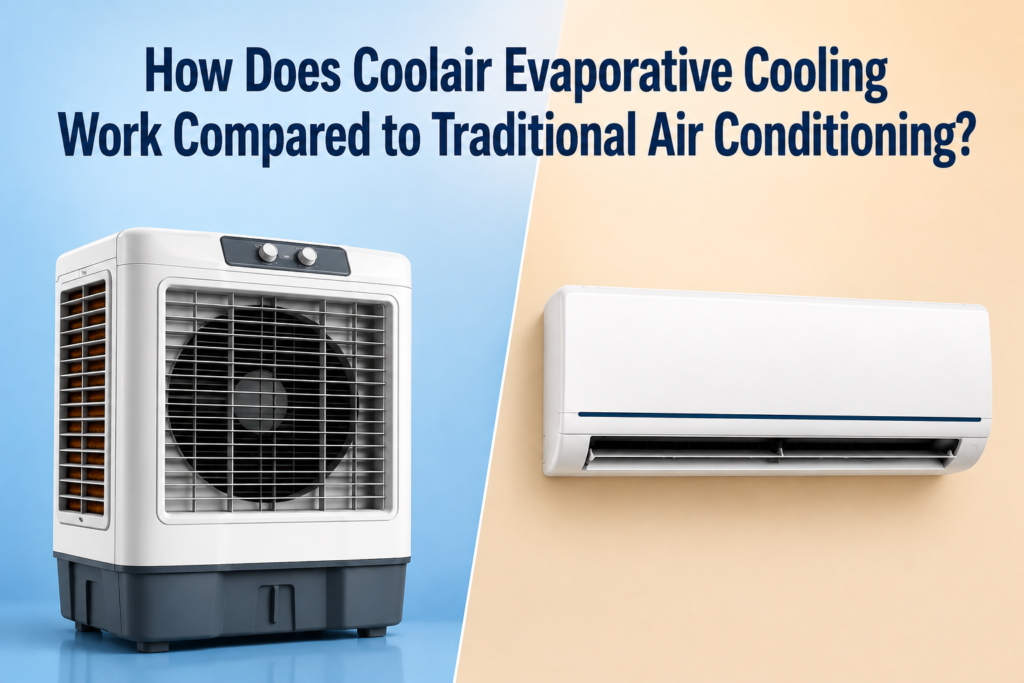
The cooling method right now affects gadget overall performance, running times, and prolonged-term widespread normal overall performance. Knowing how every generation works helps groups determine whether or not they want refrigeration-based cooling or natural evaporative cooling. The mechanism inside the lower return of each device, moreover, impacts protection schedules and machine lifespan.
When comparing Cooler Evaporative vs Traditional Air Conditioning, understanding how each system works helps you choose the right cooling solution. Both systems efficaciously lessen temperatures, but they achieve this through certainly unique engineering approaches.
How Each Cooling Technology Operates
- Water Evaporation Process: Coolair evaporative cooling pulls warm outdoor air through wet cooling pads. As water evaporates, heat is absorbed, resulting in cooler air moving into the building honestly.
- Refrigeration Cycle: A traditional air conditioner compresses refrigerant fluid, transfers warm temperature outdoors, and circulates chilled air indoors through an evaporator coil and duct gadget.
- Air Circulation Method: Evaporative coolers preserve non-stop airflow by bringing glowing outdoor air into the gap. Air conditioners normally recycle indoor air for steady temperature control.
- Cooling Speed: Air conditioners abruptly reduce indoor temperatures regardless of outdoor humidity. Evaporative cooling gives you powerful cooling regularly and performs excellently in dry climates.
- System Components: Evaporative cooling systems consist of enthusiasts, pumps, water reservoirs, and cooling pads. Traditional AC devices require compressors, condensers, evaporators, refrigerants, and electric-powered manipulation systems.
- Maintenance Requirements: Evaporative cooling typically includes cleansing cooling pads, water tanks, and pumps. Air conditioners require refrigerant inspections, clean out replacements, coil cleansing, and compressor maintenance.
Which Cooling System Is More Energy Efficient?
Universal energy performance stays taken into consideration as one of the largest worries for proprietors, warehouse managers, factories, and business-asset proprietors. Rising energy prices encourage corporations to look for cooling systems that deliver dependable performance while reducing monthly walking fees. Choosing an energy-green answer, moreover, contributes to environmental sustainability.
Cooler Evaporative vs Traditional Air Conditioning is one of the most important comparisons for businesses looking to reduce energy costs while maintaining efficient cooling. makes a specialty of energy consumption. Because evaporative cooling eliminates the need for electricity-sizable compressors, it commonly consumes appreciably an entire lot, an awful lot less electricity, than conventional air conditioning systems, making it an appealing alternative for large enterprise centers.
Reasons Evaporative Cooling Saves More Energy
- No Compressor Operation: Eliminating compressors dramatically reduces strength consumption for the reason that compressors are the most strength-extensive components in conventional air conditioning systems.
- Lower Operating Costs: Businesses frequently experience sizable discounts in month-to-month software program application payments after switching to evaporative cooling for appropriate programs.
- Reduced Peak Electricity Demand: Evaporative cooling locations put tons less stress on electric-powered infrastructure, especially in the path of periods of excessive outdoor temperatures.
- Eco-Friendly Performance: Lower electricity usage translates into fewer greenhouse fuel emissions, making evaporative cooling an environmentally accountable cooling answer.
- Sustainable Cooling Technology: Water-based genuine cooling requires fewer mechanical components and facilitates long-term sustainability obligations for business operations.
- Ideal for Large Spaces: Warehouses, production centers, workshops, and distribution facilities benefit drastically from evaporative cooling due to the fact that cooling massive volumes of air calls for a first-rate deal with a lot less strength than traditional AC.
Which Cooling System Performs Better in Different Climate Conditions?
Climate performs a high characteristic in figuring out a cooling tool’s overall performance. A solution that works incredibly well in an unmarried vicinity may deliver disappointing consequences in some different ones. Temperature, humidity, and airflow all have an effect on cooling overall performance, making it critical to evaluate neighborhood climate situations earlier than making an investment in a cooling machine.
When comparing Cooler Evaporative vs Traditional Air Conditioning, weather compatibility ought to be one of the first concerns. Dry climates allow evaporative cooling structures to gain the most overall performance, while humid environments regularly require conventional air conditioning to keep comfortable indoor conditions.
Best Climate Conditions for Each Cooling System
- Hot and Dry Regions: Evaporative cooling resources provide incredible cooling typical performance in which humidity levels are low due to the reality that water evaporation occurs more readily.
- Humid Coastal Areas: Traditional air conditioning performs better with the beneficial aid of putting off greater moisture at the identical time as cooling indoor air, developing a more comfortable environment.
- Industrial Buildings: Large warehouses and production facilities in dry climates frequently acquire large electricity financial savings using evaporative cooling technology.
- Office Buildings: Air conditioning gives regular temperature control and humidity low, making it appropriate for enclosed places of business environments.
- Seasonal Weather Changes: Businesses positioned in regions with numerous humidity tiers should compare annual climate patterns earlier than choosing a cooling solution.
- Ventilation Requirements: Evaporative cooling constantly introduces clean outdoor air, enhancing air go with the flow in business settings wherein airflow is essential.
Is Coolair Evaporative Cooling More Cost-Effective Than Traditional Air Conditioning?
Cost is one of the most important factors at the same time as deciding on a cooling device for a home, warehouse, retail store, or commercial enterprise facility. While the preliminary purchase fee is vital, the right fee of possession, moreover, includes installation, strength intake, safety, renovation, and device lifespan. Looking at the long-time-period financial impact allows one to decide which machine gives the incredible return on investment.
When comparing Cooler Evaporative vs Traditional Air Conditioning, evaporative cooling regularly proves to be the extra-cheap solution for big regions located in dry climates. Traditional air conditioning, however, can also offer a higher rate in humid environments wherein specific temperature and humidity control are essential, but it’s better to go for walks.
Why Evaporative Cooling Can Save More Money
- Lower Initial Installation Costs: Evaporative cooling structures commonly require fewer additives than traditional air conditioners. Since they do not now rely upon complicated refrigerant lines or compressors, setup is commonly quicker and, in addition, a great deal less highly priced.
- Reduced Monthly Energy Bills: One of the most important financial advantages of evaporative cooling is its low electricity consumption. Businesses working with cooling structures for lengthy hours often warrant large reductions in month-to-month software fees.
- Affordable Maintenance: Maintenance usually includes cleaning cooling pads, checking water pumps, and analyzing the water distribution system. These obligations are less high-priced than servicing compressors and refrigerant circuits.
- Long-Term Operational Savings: Lower electricity consumption combined with much less hardware maintenance contributes to reduced going-on-walks expenses inside the path of the system’s lifespan, making evaporative cooling a practical finding.
- Scalable for Commercial Buildings: Warehouses, factories, and production centers can cool large regions efficiently without dramatically developing energy fees, enhancing commonplace operational efficiency.
- Higher Costs for Traditional AC: Traditional aircon commonly includes better installation charges, greater electricity utilization, and extra commonplace professional servicing, developing traditional ownership prices through the years.
Which Cooling System Requires Less Maintenance?
Regular maintenance is critical for ensuring everyday performance, extending gadget lifespan, and stopping sudden breakdowns. Every cooling device calls for ordinary care. However, the complexity and frequency of renovation variety rely on the generation used. Understanding the ones’ versions lets organizations and residence proprietors finance extended-time-period renovations.
The assessment of Coolair Evaporative Cooling vs. Traditional Air Conditioning: Which Is Better? often highlights upkeep as a finding-out problem. Because evaporative cooling structures encompass fewer mechanical components and do not use refrigerants, they will typically be easier and a lot less pricey to maintain than conventional air conditioning structures.
Maintenance Comparison Between Both Systems
- Cooling Pad Cleaning: Evaporative coolers require periodic cleansing or substitution of cooling pads to keep airflow and cooling performance overall. Keeping the pads smooth also allows beautifying indoor air remarkably.
- Water System Inspection: Pumps, water reservoirs, and distribution traces want to be inspected often to ensure right water movement and save you mineral buildup.
- Filter Maintenance: Traditional air conditioners require regular clearing out and substitution to maintain airflow and prevent dust accumulation. Dirty filters reduce performance and increase strength consumption.
- Refrigerant and Compressor Servicing: Air conditioning systems require professional inspections to check refrigerant levels, compressor overall performance, and refrigerant leaks, which could boost protection expenses.
- Seasonal System Checks: Both cooling systems benefit from seasonal inspections earlier than the pinnacle summer season utilization. Routine servicing permits one to end up privy to capability issues in advance rather than highly priced repairs.
- Equipment Longevity: Proper maintenance improves the lifespan of both technologies. However, the less complicated format of evaporative cooling structures frequently results in decreased repair costs and much fewer detailed screw-ups.
Which Option Is Better for Homes, Businesses, and Warehouses?
The ideal cooling answer relies upon where it’ll probably be used. Residential homes, business places of work, retail stores, warehouses, and production floors each have unique cooling necessities. Factors that consist of building size, occupancy, air going with the waft wishes, and neighborhood weather all have an effect on which technology plays first-rate.
When comparing Coolair Evaporative Cooling vs. Traditional Air Conditioning: Which Is Better?, there may be no single answer that fits each scenario. Instead, selecting the right device is predicated upon matching the era to the surroundings and operational requirements.
Choosing the Right Cooling System
- Residential Homes: Traditional air conditioning is commonly desired for houses because it gives particular temperature manipulation, powerful humidity removal, and year-round comfort in various climates.
- Warehouses: Evaporative cooling is an exceptional preference for warehouses because of its functionality to chill huge open areas whilst preserving non-foreseeable easy air waft and low running costs.
- Manufacturing Facilities: Factories benefit from evaporative cooling due to the fact improved air drift permits creating an extra snug operating environment at the same time as decreasing ordinary energy consumption.
- Retail Stores: Retail environments may also additionally use each technology, relying on neighborhood climate situations. Air conditioning works properly in humid regions, while evaporative cooling is quite powerful in dry climates.
- Commercial Offices: Office buildings generally require sturdy temperatures and humidity control. Traditional air conditioning usually gives higher consideration for enclosed office regions.
- Agricultural and Industrial Applications: Greenhouses, workshops, livestock centers, and business florists frequently rely on evaporative cooling due to its affordability, power performance, and capacity to deliver non-forceful glowing airflow.
What Should You Consider Before Choosing Between Coolair Evaporative Cooling and Traditional Air Conditioning?
Selecting the right cooling system requires more than comparing purchase fees. Every property has precise cooling needs based totally on its location, layout, occupancy, air drift requirements, and rate range. A cautious evaluation of those factors lets us be certain the chosen device substances are reliable, common, basic, overall performance, and long-term cost.
Before growing a very ultimate choice on Coolair Evaporative Cooling vs. Traditional Air Conditioning: Which Is Better?, remember each has different needs and running costs. Consulting a professional cooling professional can also help you emerge as more aware about the most appropriate answer for your construction and weather.
Important Factors Before Buying
- Local Climate Conditions: Evaluate common humidity and summertime temperatures. Dry climates maximize the performance of evaporative cooling, even as humid regions typically require conventional air conditioning.
- Building Size: Larger commercial business enterprises and business agency spaces often benefit from evaporative cooling because of the fact that it is able to cool extensive regions with lower electricity intake.
- Energy Efficiency Goals: Organizations focused on lowering power utilization and carbon emissions can also discover evaporative cooling better aligned with sustainability desires.
- Budget Planning: Compare not-great setup prices; however, moreover, predict strength payments, protection fees, and destiny repair charges before creating a purchase.
- Ventilation Requirements: If easy air circulation is a problem, evaporative cooling affords non-restricted airflow. Traditional air conditioning focuses extensively on talking about temperature and humidity control.
- Long-Term Business Needs: Consider destiny growth, operational hours, and cooling desires. Choosing a scalable cooling answer can reduce destiny upgrade costs and enhance widespread overall performance.
Conclusion
Choosing Cooler Evaporative vs Traditional Air Conditioning depends on your climate, budget, and long-term cooling requirements. weather conditions, and lengthy-term operational goals. Both structures are designed to create cushy indoor environments; however, they attain this through the usage of high-quality generation that offers specific blessings.
For businesses in hot and dry regions, Cooler Evaporative vs Traditional Air Conditioning often favors evaporative cooling because of its lower energy consumption. Warehouses, factories, workshops, and large enterprise facilities can significantly lessen walking costs even while keeping snug running situations through evaporative cooling structures.
On the other hand, conventional air conditioning remains the preferred preference for homes, places of work, hospitals, hotels, and commercial enterprise homes located in humid climates.
Explore our recent Blog:
Coolair Evaporative Cooling: Why Businesses Are Switching
Frequently Asked Questions (FAQs)
The number one difference lies in the cooling method. Coolair evaporative cooling uses the natural evaporation of water to reduce air temperature, at the same time as conventional air conditioning is predicated on refrigerants and compressors to push warmth from indoor spaces. As a consequence, evaporative cooling generally consumes a good deal much less electricity and gives continuous smooth air, while conventional AC gives better humidity management and precise temperature regulation.
Yes, in most warm and dry climates, evaporative cooling is significantly a brilliant deal less high-priced to carry out, as it requires hundreds of watts less power than conventional air conditioning. Since it does not use energy-excellent compressors, monthly utility payments are often notably lower. However, the actual economic financial savings depend on weather situations, building periods, and gadget utilization.
Evaporative cooling is regularly the famous solution for warehouses, factories, workshops, and manufacturing floors, as it efficaciously cools large open areas at the same time as supplying glowing outdoor air. It additionally reduces electricity consumption and walking costs, making it perfect for business and business packages. Traditional air conditioning can also, despite the fact that it is energy-intensive, be crucial in facilities requiring strict temperature and humidity control.
Evaporative cooling plays an excellent role in warm and dry environments in which water can evaporate efficiently. In humid regions, the cooling effect is decreased due to the reality that the air already consists of excessive ranges of moisture. Traditional air conditioning is commonly the higher alternative for humid climates because it gets rid of more humidity at the identical time as cooling indoor regions.
Coolair evaporative cooling systems commonly require lots less upkeep because of the fact they have got fewer mechanical parts and do not rely on refrigerants or compressors. Regular preservation specifically consists of cleansing cooling pads, inspecting the water pump, and checking the water distribution device. Traditional air conditioners require extra servicing, which includes refrigerant inspections, compressor renovation, clear-out replacements, and coil cleaning.
Start by evaluating your neighborhood climate, building length, air-watt requirements, energy-performance dreams, and charge variety. If you use it in dry weather and want to kick back in a huge enterprise or enterprise area, evaporative cooling is regularly the maximum charge-effective answer. If you need particular temperature management and humidity cut charges, particularly in humid areas or residential houses, conventional air conditioning is typically the better preference.